Saturday

Chiang Rai Tourist Information

Chiang Rai, Thailand's furthest northern province, is about 785 kms. from Bangkok and 580 meters above sea level. Its area, mostly covered with mountains, is 11,678 square kilometers. The most important river is Mae Kok; which is about 130 kilometers long.

Administration is divided into 13 Amphoes and 3 King Amphoes Muang, Chiang Kong, Chiang Saen, Mae Chan, Mae. Sai, Mae Suai, Pa Daet, Phan, Thoeng, Wiang Pa Pao, Wiang Chai, Phaya Mengrai, Wiang Kaen and King Amphoe Mae Fa Luang, Khun Tan, Mae Lao.

Chiang Rai was founded in 1262 A.D. by King Mengrai, whose 'statue can be easily seen on the way to Mae Chan. It used to be the capital of Lanna Kingdom and later was conquered by Burma. It was not until 1786 that Chiang Rai became Thai territory and proclaimed a province during the reign of King Rama VI in 1910 A.D. Nowadays Chiang Rai is famous for its tasty lychees and the Golden Triangle in Amphoe Chiang Saen.


CHIANG RAI's ATTRACTIONS

Monument of King Mengrai the Great This monument is situated at the starting point of the road to Mae Chan, Chiang Saen and Mae Sai.

Ku Phra Chao Mengrai This stupa is situated in Wat Ngam Muang on Doi Ngam Muang in Chiang Rai Township area. It is the place where ashes and relics of King Mengrai are housed.

Wat Phrasing Where legend holds that an important The ravada image was located, has been restored for many times to allow accurate dating, but documents suggest the 15th century or earlier.

Wat Phra Keo Situated behind Wat Phrasing, is believed to have been the original residence of the Emerald Buddha which is now in Bangkok at the Royal Temple of the same name.

Phrathat Doi Chom Thong This pagoda is located on Doi Chom Thong on the bank of Mae Kok River near the city of Chiang Rai.

Handicraft Center is about 3 kilometers from town on Mae Chan Road. It offers demonstration of weaving and ceramic making, sales of goods made at the center and Burmese goods.

Mae Fa Luang Farm is a foundation located at Ban Pa Ngiu, Tambon Robwiang, about 3 - 4 kilometers from Chiang Rai township. The foundation is a temporary shelter for hilltribe children.

Rafting The Mae Kok River, 130 kms. long, running through the heart of Chiang Rai, is said to be one of the most beautiful and unspoil rivers of the world. It flows gently along jungle banks and towering mountain cliffs. Along its route lie several hilltribes and jungle - tribes of Chiang Rai. The people are friendly and the life aboard the raft relaxing. There are regular well - organized rafting trips to and from Chiang Rai to many interesting destinations: A popular tours rafting from Chiang Mai to Chiang Rai, or vice versa.

Rattana Garden Situated along Chiang Rai Mae Chan Highway about 18 kms. from the city. This scenic place, under the management of the private sector, has the area of over 40 acres. It comprises of plants and flowers of different colour and species, together with accommodations provided for tourists.

Doi Luang National Park covers areas in Amphoe Phan, Amphoe Wiang Pa Pao of Chiang Rai, and some part of Lampang and Phayao. To get to the park is by taking Chiang Rai - Phayao Highway for 58 kms. to Ban Pu Kaeng, turn right at km. 773 for another 9 kms. Main attraction is Namtok Pu Kaeng It is the largest waterfall in Chiang Rai, having strong current cascading all year round.

Mae Sai is Thailand's northern most border district to Chiang Saen A small town about 30 kms. further from Mae Chan. Its lovely setting on the Mae Khong River strongly enchants the charm of its old temples ; Wat Pa Sak , Wat Phrathat Chom Kitti etc.

Wiang Ka Long is located along Chiang Rai-Chiang Mai Route, about 16 kms. from Amphoe Wiang Pa Pao. This is where the ancient kilns called "Ka Long Kiln" have been excavated.

Mae Chan is about 29 kms. to the north Chiang Rai. It serves as a trading post of Akha and Yao hillpeople who sell their goods and buy manufactured items. You can find some silver and other tribal handicrafts at the shops in this town.

Hilltribes There are many main tribes around Chiang Rai, Mae Chan, Mae Sai and along Mae Kok River such as the Yao, the Akha, the Blue and White Maeo, Lisu, Lahu, Lahu Shi and Skaw and Karen. Each main group speaks its own language, follows animist customs (based on a belief in spirits) as well as adhering to other more recently adopted religious beliefs. Each of the main tribes language, custom and production attracts tourists by its own mysterious charm. There is the Hilltribe Developments and Welfare Center in Amphoe Mae Chan, along the route to Doi Mae Salong. Hand-made handicraft including woven cloth products and silverware are for sale in the centre.

Doi Mae Salong located about 45 kms. to the north of Amphoe Mae Chan, is one of the places allowed by Thai Government for some of the Chinese refugees from Myanmar to settle in. The village founded is called Santi Khiri. It has become well-known among tourists both Thais and foreigners for its enchanting beautiful scenery, calm and placid nature. There are guest houses and tourist houses with recreation activities provided such as house riding and elephant riding.

Phrathat Doi Tung is the holy relic that draws devout Buddhists from as far as Laos and Myanmar for annual worshipping. The reliquary is atop the highest Chiang Rai mountain at Doi Tung, elevation 2,000 meters above sea-level. The shrine is reached by a torturous mountain road, winding its way up and down mountain sides for 17 kms. off Highway No. 110, 48 kms. from Chiang Rai township. The unmatched panoramic view reaches out to Myanmar and Laos on the horizon.

Phra Tamnak Doi Tung A beautiful royal residence is built for the Princess Mother on the way to Phrathat Doi Tung. The main attraction is Suan Mae Fa Luang , a very beautiful garden decorated with different kinds of plants and flowers. The garden is open to visitors daily from 06.00-18.00 hrs.

Chiang Saen National Museum is in Chiang Saen town and one of the most famous museums in Thailand for ancient Buddha images and antiques. The museum is open from 9.00 a.m. -16.00 p.m. everyday except Monday, Tuesday and official holidays.

Golden Triangle The most famous attraction where the borders of the three countries; Laos Thailand and Myanmar meet. It is about 9 kilometers north of Chiang Saen. From this place, Laotian and Myanma border can be seen through Mae Khong and Ruak River respectively. Accommodations are available for tourists who want to stay over night. Boats can be rented for trips along the Khong River.

Chiang Saen Lake To get to the lake, travel five kilometres from Chiang Saen along Highway No. 1016, turning left at Km. 27, for a further two kilometres. The lake's one square kilometre of water is home to waterfowl during the winter months. Accommodations are available.

Chiang Khong Located 114 kilometres northeast of Chiang Rai and 55 Kilometres east of Chiang Saen, this is a small district by the Khong River. Its fame lies in its cloth weaving at Ban Hat Bai and, in the Khong River, the Pla Buk the world's largest freshwater cat fish capable of reaching 2.5 metres long and weighing 300 kilograms. Each April celebrations are held when the giant fish are caught. At the Chiang Khong Fishery Station, fertilisation of the fish can be witnessed.

Lychee Fair This annual fair is held in May. Chiang Rai, Thailand's northernmost province, is known for the high quality of the lychees that grow in its orchards, and this fair celebrates the harvest season. In addition to sales of the fruit, there are displays of other agricultural products and local handicrafts and a beauty contest to select Miss Lychee.

Articles Source : http://www.hotelthailand.com

Tuesday

Spa in Thailand

Spa in Thailand

Introduction

The word ‘spa’ probably comes from the name of the town Spa in Belgium.

East meets West, a spa is a place to go to treat and heal your mind, body and spirit using a variety of different techniques such as massage, scrubs, yoga, acupuncture, reike, reflexology, nutrition and body wraps etc.

Six Senses Desination Spa, Phuket, Thailand


Back ground / History of Spa in Thailand

Introduced in the early 1990s, spas in Thailand are a relatively new phenomenon – but one though, which has only very recently sky-rocketed in popularity. Not only are spas popular and fashionable with foreign tourists and expatriates, but the local Thais are also enjoying this new alternative therapy, one which is often ideal to ensure a smooth natural balance. A balance that has been rocked in Bangkok in particular by the unhealthy, serious life-styles and polluted environs. At first, spas were only to be found in 5-star hotels but they have now mushroomed everywhere.

Thailand: Asia’s Spa Capital

Thailand is a destination to indulge in this pastime therapy. The country prides itself in countless spas offering the highest world-class services at extremely reasonable rates. Much of the recent success of this therapy is due to the tremendous support given by the Thai Spa Operators Association. Not only have they assisted in the training of therapists to international standards, but they have also trained them in keeping methods traditionally and distinctively ‘Thai-style’. And it is this kind of service along with the one and only Thai Smile that are the key factors for so many visitors to revisit a Thai spa. Furthermore, most clients walk away from the spa with their head held high in the air with a feeling of rejuvenation and a well-being of mind, body and soul. Thai spas are not only quantity, but also quality. Spas can be found at all the major tourist destinations in Thailand such as: Bangkok, Phuket, Pattaya, Ko Samui, Chiang Mai and Hua Hin.Beach Pool @ The Ravindra Beach Resort & Spa (Pattaya, Thailand)

Facts and Stats

During the years 2000-2002, the growth of the spa industry in Thailand rocketed by an exhilarating 64% and since 1999 Thailand has secured itself a top-5 world rating. In fact, Thailand is the second highest ranked spa destination of the world with an overall grade of 93%+ (just slightly behind Australia).

Chiva Som International Health Resort located in Hua Hin, is ranked number one in the world while the Regent Chiang Mai Resort and Spa is ninth.

During the period June 2001 – June 2002, 230 operators serviced 2.5 million international clients, creating revenue of $85 million. This amount well exceeds that of competitive countries, such as Singapore ($35 million) and Australia ($15 million). In total, 79% of all clients were foreigners.

Services and Hospitality

Thailand is a friendly country and a must-go for all those who enjoy nothing more than a rejuvenating spa. The country is famed for its world-class natural healing techniques and especially Thai massage. For those who appreciate the authentic Thai way of life, there are numerous home-stays, including those in the unique hill tribe villages of the north.

Thailand, home of Theravada Buddhism, is the ideal location to do a bit of spiritual soul-searching and reap the benefits of Vipassana meditation, a technique which has exploded in popularity in Western countries. Then, there is the sumptuous cuisine to wine and dine on, with cooking classes available too.

Reasons for Thailand’s spa popularity

Well, for one, they are rather different to the ones found in the West. The spas in Thailand are based on the deep-rooted harmony of Buddhist teaching, so creating an inner spiritual calm, complementing the equation of mind, spirit and body. Meditation is also used. Spas in Thailand have an altogether very Thai touch embodied upon a time-honoured healing tradition based on herbal and holistic remedies and generations of folk wisdom.

Thailand also offers award winning service at reasonable rates and makes a beautiful spot for a holiday vacation.

Reasons why most people go to a spa in Thailand

Thailand prides itself as having some of the finest spas in the world offering services at extremely competitive rates. Since Thailand has never been colonialized, the original culture has remained embedded within society and foreign visitors will find the Thais very hospitable and friendly.

Not only does Thailand, boast some of the most dazzling islands and beaches in the world, but also year-long sunshine; perfect for those who wish to get a lovely shiny suntan.

Thailand has an abundance of reasonably priced top quality accommodation where for the equivalent price of a completely basic home-stay in Europe, visitors to Thailand can enjoy the luxury of a four-star hotel. Then to top that off, they can soothe their aching minds with ancient Buddhist a meditation technique, qi gong, tai chi, solar bath and yoga.

3. Thailand’s Spas

There are numerous different types of spa services in Thailand which focus heavily on Thai massage. They are categorized as massage for health, massage for beauty and traditional massage.

The myriad variety of spas in Thailand is quite phenomenal and is found at almost every destination in Thailand. They are:

- Destination spa, Destination spa, the famous destination spa in Thailand is no doubt, the one and only Chiva Som which attracts floods of visitors from all around the world who come to Thailand specifically to be pampered there.

- Hotel spas / Resort spas / Retreat spas: Popular spas like there can be found at the top hotels in the major tourists destinations such as: Phuket, Pattaya, Hua Hin, Bangkok, Ko Samui and Chiang Mai.

Popular Hotel and Resort Spas are:

Bangkok -
The Oriental, Imperial Queen’s Park, JW Marriott Hotel, Marriott Royal Garden Riverside, The Regent Bangkok, Peninsula Bangkok, Sheraton Grande Sukhumvit, Sofitel Central Plaza, Thavorn Beach Village, The Westin Banyan Tree

Phuket -
Amanpuri Resort, Banyan Tree Phuket, Central Karon Village, Diamond Cliff Resort & Spa, Dusit Laguna Resort Hotel, The Evason Phuket, Pearl Village, Sheraton Grande Laguna Phuket

Koh Samui -
Central Samui Beach Resort, Central Samui Village, Health Oasis Resort, The Samui Dharma Healing Center, Santiburi Dusit Resort, The Spa Resort and Health Center, Tamarind Retreat

Pattaya -
Central Wong Amat Beach Resort, Royal Cliff Beach Resort

Hua Hin
- Chiva-Som, Melia Hua Hin, The Evason Hua Hin, Royal Garden Resort, Royal Garden Village, Sofitel Central Hua Hin Resort

Chiang Mai - The Regent Resort Chiang Mai (Lanna Spa)

Sunday

Phuket : Travel in Phuket

Phuket is an island in the south of Thailand. Phuket may also refer to:
  • Phuket Province, which covers the complete island plus a few small neighboring islands
  • Phuket (city), the main town in the southeast of the island
  • Amphoe Mueang Phuket, the district covering the south of the island around Phuket town
  • Monthon Phuket, a cluster of provinces covering all the western coastal provinces, dissolved in 1933

Phuket (Thai: ภูเก็ต, IPA: [pʰuːkɛt]; formerly known as Tha-Laang or Talang, or Junk Ceylon in Western sources, a distortion of the Malay Tanjung Salang, i.e. "Cape Salang")[1] is one of the southern provinces (changwat) of Thailand. Neighbouring provinces are (from north clockwise) Phang Nga and Krabi, but as Phuket is an island there are no land boundaries.

Phuket, which is approximately the size of Singapore, is Thailand’s largest island. The island is connected to mainland Thailand by a bridge. It is situated off the west coast of Thailand in the Andaman Sea. Phuket formerly derived its wealth from tin and rubber, and enjoyed a rich and colorful history. The island was on one of the major trading routes between India and China, and was frequently mentioned in foreign ship logs of Portuguese, French, Dutch and English traders. The region now derives much of its income from tourism.

Name

The name Phuket (of which the ph sound is an aspirated p) is apparently derived from the word bukit (Jawi: بوكيت) in Malay which means hill, as this is what the island appears like from a distance. The region was formerly referred to as "Thalang," derived from the old Malay "Telong" (Jawi: تلوڠ) which means "Cape." The northern district of the province, which was the location of the old capital, still uses this name.

History

The French ambassador Chevalier de Chaumont with king Narai.

In the 17th century, the Dutch, the English, and from the 1680s the French, competed with each other for trade with the island of Phuket (the island was named Junk Ceylon at that time), which was valued as a very rich source of tin. In September 1680, a ship from the French East India Company visited Phuket and left with a full cargo of tin. In 1681 or 1682, the Siamese king Narai, who was seeking to reduce Dutch and English influence, named Governor of Phuket the French medical missionary Brother René Charbonneau, a member of the Siam mission of the Société des Missions Etrangères. Charbonneau held the position of Governor until 1685.[2]

In 1685, king Narai confirmed the French tin monopoly in Phuket to a French ambassador, the Chevalier de Chaumont.[3] Chaumont's former maître d'hôtel Sieur de Billy was named governor of the island.[4] The French were expelled from Siam in 1688 however, following the 1688 Siamese revolution. On April 10, 1689, the French general Desfarges led an expedition to re-capture the island of Phuket in an attempt to restore some sort of French control in Siam.[5] The occupation of the island led nowhere, and Desfarges returned to Pondicherry in January 1690.[6]

The Burmese attacked Phuket in 1785. Captain Francis Light, a British East India Company captain passing by the island, sent word to the local administration that he had observed Burmese forces preparing to attack. Than Phu Ying Chan, the wife of the recently deceased governor, and her sister Mook(คุณมุก) then assembled what forces they could. After a month-long siege, the Burmese were forced to retreat March 13, 1785. The two women became local heroines, receiving the honorary titles Thao Thep Krasatri and Thao Si Sunthon from King Rama I. During the reign of King Chulalongkorn (Rama V), Phuket became the administrative center of the tin-producing southern provinces. In 1933 Monthon Phuket (มณฑลภูเก็ต)was dissolved and Phuket became a province by itself. Old names of the island include Ko Thalang.

Geography

Phuket
PhuketMap.png
Map of Phuket (beaches in brown)
Geography
Location Andaman Sea
Coordinates 7°53′24″N 98°23′54″E / 7.89°N 98.39833°E / 7.89; 98.39833
Area 543.0 square kilometres (209.7 sq mi)
Length 50 kilometres (31 mi)
Width 20 kilometres (12 mi)
Highest point Mai Thao Sip Song (529 metres (1,740 ft))
Country
Thailand
Demographics
Ethnic groups Thai, Malay
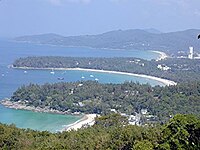
Looking north from Kata View Point over Kata Noi Beach, Kata Beach and Karon Beach

Phuket is the biggest island in Thailand, located in the Andaman Sea of southern Thailand. The island is mostly mountainous with a mountain range in the west of the island from the north to the south. The mountains of Phuket form the southern end of the Phuket mountain range, which ranges for 440 km from the Kra Isthmus. The highest elevation of the island is Mai Thao Sip Song (Twelve Canes), at 529 m above sea level.

It is estimated that Phuket has a total area of approximately 570 square kilometers (including the provinces other islands). Phuket is approximately 536 miles (862 kilometers) south of Bangkok, and covers an area of approximately 134,178 acres (543 square kilometers) excluding small islets. It is estimated that if all its 39 other small islands are included, Phuket Province will cover an area of approximately 145,792 acres (590 square kilometers). The island total length, from north to south, is estimated at 30 miles (48.7 kilometers) and 13 miles (21.3 kilometers) wide.[7]

Phuket's topology is exceptional with 70 percent of its area covered with mountains which stretch from north to south and the remaining 30 percent being plains located in the central and eastern parts of the island. The island does not have any major rivers except for a total of 9 brooks and creeks.

Forest, rubber and palm oil plantations cover 60% of the island.[citation needed] The western coast has several sandy beaches, while on the east coast beaches are more often muddy. Near the southernmost point is Laem Promthep (Brahma's Cape), which is a popular sunset viewing point. In the mountainous north of the island is the Khao Phra Thaeo Non-hunting Area, protecting more than 20 km² of rainforest. The three highest peaks of this reserve are the Khao Prathiu (384 m), Khao Bang Pae (388 m) and Khao Phara (422 m). The Sirinat National Park on the northwestern coast was established in 1981 and protects an area of 90 km² (68 km² marine area), including the Nai Yang beach where sea turtles lay their eggs.

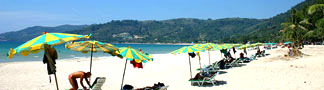
One of the most popular tourist areas on Phuket is Patong Beach on the central western coast, perhaps owing to the easy access to its wide and long beach. Most of Phuket's nightlife and its cheap shopping is located in Patong, and the area has become increasingly developed. Patong means "the forest filled with banana leaves" in Thai. Other popular beaches are located south of Patong. In a counterclockwise direction these include Karon Beach, Kata Beach, Kata Noi Beach, and around the southern tip of the island, Nai Harn Beach and Rawai. To the north of Patong are Kamala Beach, Surin Beach and Bang Tao Beach. These areas are generally much less developed than Patong, and sought out by individuals, families and other groups with a preference for more relaxed and less crowded environs than Patong. There are many islands to the southeast, including Bon Island, just a short boat trip away. There are several coral islands to the south of Phuket, the Similan Islands lie to the north west, and Phi Phi Islands to the south east. Islanders engage in a lively tourist trade, catering to snorkellers and scuba divers.

Administrative divisions

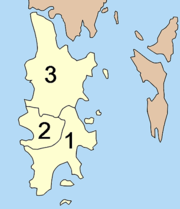
Map of Amphoe, or the three districts of Phuket

Phuket is divided into 3 districts (Amphoe), which are further subdivided into 17 subdistricts (tambon) and 103 villages (muban).

  1. Mueang Phuket
  2. Kathu
  3. Thalang

There are 9 municipal (thesaban) areas within the province. The capital Phuket has city (thesaban nakhon) status, and the main touristical town Patong as well as Kathu has town (thesaban mueang) status. There are further 6 subdistrict municipalities (thesaban tambon) - Karon, Thep Krasattri, Choeng Thale, Ratsada, Rawai and Wichit. The non-municipal areas are administrated by 9 tambon administrative organizations (TAO).

Climate

Phuket has a tropical climate with a dry season from November to April and a rainy season from May to October. Average temperatures are consistent year-round. Average highs range from 29 °C (84 °F) to 33 °C (91 °F); average lows range from 23 °C (73 °F) to 26 °C (79 °F).


Phayao: Travel in Phayao

Phayao

Phayao has an overall area of 6,355 square kilometers and is administratively devided into 7 Amphoes (Districts) and 2 King Amphoes (Subdistrict): Amphoe Muang, Chun, Chiang Kham, Chiang Muan, Dok Kham Tai, Pong, Mae Chai, King Amphoe Phu Kam Yao and King Amphoe Phu Sang. Phayao is located 690 kilometers from Bangkok.

What to see and what to do in Phayao?

Wat Si Umong Kham has a pagoda of the Chiang Saen Period in perfect conditions. This monastery also houses the Buddha image "Luang Po Ngam Muang Ruang Rit" or the so-called "Phra Chao Lan Tu". It is regarded as the most beautiful Buddha image of Lanna Thai and a unique artistic symbol of Phukamyao, the ancient Phayao Kingdom.

Wat Si Khom Kham is located in Amphoe Muang on the bank of Phayao Lake (commonly called "Wat Phra Chao Ton Luang") and houses a principal Bhudda image having a lap width of 14 meters, height of 17 meters. The annual fair takes place every May. Located within the monastery compound is "Ho Thai Nithat", a building with antiques, literary items, local intellectual displays and Phayao's life style scenes are shown.

Phayao Lake
Phayao lake

Wat Analayo is on Doi Busarakham, 20 kms. from town to the north. It is a large temple built by a Thai monk, who was known as "Phra Kru Phaiboon". Within its wide compound, resides a big, beautiful Buddhist image of the Sukhothai style, as well as, many other interesting structures.

Doi Luang National Park covers areas in Chiang Rai, Lampang and Phayao. The main attraction in Phayao's area is " Champa Thong Waterfall". This beautiful waterfall is situated at Km. 7 on Phayao-Chiang Rai Highway, about 18 kms. from town.

Wiang Lo Ancient Town or "Muang Phra Lo" is located around 17 kilometers away from Amphoe Chun along highway no. 1021. At Ban Huai Ngiu, there is a branch to Ban Nam Chun, which is about 12 kilometers along a dusty road. From the remainings of the old city walls and a lot of deserted temples, the site was assumed to be a city in the reign of Pho Khun Ngam Muang (King Ngam Muang). Here, an old monastery "Wat Si Ping Muang" is located. As this area is adjacent to the point where the Chun River runs to join the Ing River. It is locally called "Sop Ing" (a meeting point).

Nam Pin Waterfall is located at Mu 9, Tambon Fai Kwang, Amphoe Chiang Kham. It cascades from a 10 meter high cliff and is 107 kms. from the township area by road.

Articles Source: http://travel.thainn.com

Phayao: Travel in Phayao

Phayao

Phayao has an overall area of 6,355 square kilometers and is administratively devided into 7 Amphoes (Districts) and 2 King Amphoes (Subdistrict): Amphoe Muang, Chun, Chiang Kham, Chiang Muan, Dok Kham Tai, Pong, Mae Chai, King Amphoe Phu Kam Yao and King Amphoe Phu Sang. Phayao is located 690 kilometers from Bangkok.

What to see and what to do in Phayao?

Wat Si Umong Kham has a pagoda of the Chiang Saen Period in perfect conditions. This monastery also houses the Buddha image "Luang Po Ngam Muang Ruang Rit" or the so-called "Phra Chao Lan Tu". It is regarded as the most beautiful Buddha image of Lanna Thai and a unique artistic symbol of Phukamyao, the ancient Phayao Kingdom.

Wat Si Khom Kham is located in Amphoe Muang on the bank of Phayao Lake (commonly called "Wat Phra Chao Ton Luang") and houses a principal Bhudda image having a lap width of 14 meters, height of 17 meters. The annual fair takes place every May. Located within the monastery compound is "Ho Thai Nithat", a building with antiques, literary items, local intellectual displays and Phayao's life style scenes are shown.

Phayao Lake
Phayao lake

Wat Analayo is on Doi Busarakham, 20 kms. from town to the north. It is a large temple built by a Thai monk, who was known as "Phra Kru Phaiboon". Within its wide compound, resides a big, beautiful Buddhist image of the Sukhothai style, as well as, many other interesting structures.

Doi Luang National Park covers areas in Chiang Rai, Lampang and Phayao. The main attraction in Phayao's area is " Champa Thong Waterfall". This beautiful waterfall is situated at Km. 7 on Phayao-Chiang Rai Highway, about 18 kms. from town.

Wiang Lo Ancient Town or "Muang Phra Lo" is located around 17 kilometers away from Amphoe Chun along highway no. 1021. At Ban Huai Ngiu, there is a branch to Ban Nam Chun, which is about 12 kilometers along a dusty road. From the remainings of the old city walls and a lot of deserted temples, the site was assumed to be a city in the reign of Pho Khun Ngam Muang (King Ngam Muang). Here, an old monastery "Wat Si Ping Muang" is located. As this area is adjacent to the point where the Chun River runs to join the Ing River. It is locally called "Sop Ing" (a meeting point).

Nam Pin Waterfall is located at Mu 9, Tambon Fai Kwang, Amphoe Chiang Kham. It cascades from a 10 meter high cliff and is 107 kms. from the township area by road.

Articles Source: http://travel.thainn.com

THAILAND MAP

THAILAND MAP